
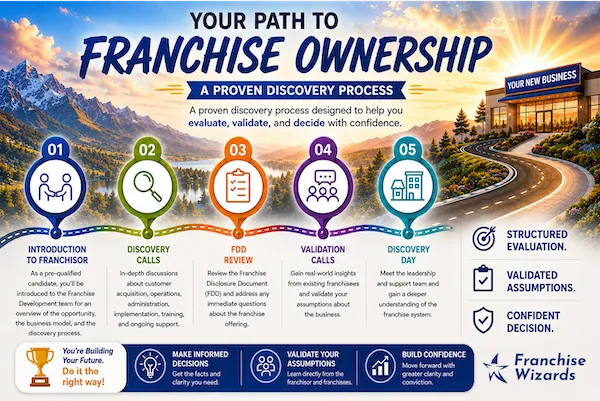
Understanding the Franchise Discovery Process
A Mutual Evaluation. Not a Sales Pitch.
When people hear the word “discovery,” they often assume it is a polished sales presentation designed to convince them to buy a franchise.
It is not.
The franchise discovery process is a structured, professional mutual evaluation. Both parties are assessing fit. The franchisor is evaluating you as a potential long-term partner. You are evaluating whether the brand, leadership team, and business model align with your goals, resources, and lifestyle expectations.
No one is trying to “close” you. The objective is clarity.
Below is a clear overview of how the process typically unfolds.
Step 1: Introduction to Franchisor
The franchise discovery process begins with a warm introduction to the Franchise Development team.
Unlike a cold inquiry submitted through a franchisor's website, candidates introduced through Franchise Wizards have already completed a business profile and preliminary qualification process. This allows the conversation to start at a much higher level.
The purpose of this initial call is to provide an overview of the franchise opportunity, explain the business model, and outline the steps involved in the discovery process.
It is also an opportunity for both parties to begin getting to know each other. The franchisor can better understand your goals, experience, and expectations, while you gain a clearer understanding of the opportunity and determine whether it deserves further evaluation.
Step 2: Discovery Calls
Discovery calls are a series of structured conversations with the franchise development team and brand leadership.
These calls are usually conducted over video calls and cover:
The business model in more detail, including customer acquisition, recruiting, operations, management, unit economics, back-office support, brand positioning and any differentiators.
Territory availability and demographics
Business implementation, training, launch and continuous support
A day in the life of a franchisee, including franchisee’s role, roles that can be delegated to employees or outsourced to third parties
Q&A to clarify any important points
This is not a one-sided presentation. It is a dialogue.
A strong franchisor will ask thoughtful questions. They are not just checking liquidity. They are assessing alignment, commitment, and long-term potential.
At the same time, you should be asking questions about support, training, marketing, staffing, scalability, and growth opportunities.
The discovery calls are designed to provide enough information for both parties to determine whether there is a strong mutual fit.
Step 3: FDD Review
Once initial alignment is confirmed, the franchisor will provide the Franchise Disclosure Document (FDD).
The FDD is a legal document regulated at the federal level. It contains detailed information about:
The franchisor’s history and leadership
Initial investment ranges
Ongoing fees and royalties
Litigation and bankruptcy history
Franchisee turnover
Territory rights
Financial Performance Representations (if provided in Item 19)
This step is analytical.
You should review the FDD carefully and, before making any firm commitments, ideally run it by a franchise attorney. This is where you verify that the numbers, structure, and legal framework make sense for your situation.
The FDD is not a marketing brochure. It is a compliance document. Take your time.
Ideally, you would start preparing a simple P&L proforma ahead of the validation calls, so you can use the validation calls as an opportunity to find the key performance indicators that allow you to calibrate your rough model.
The exercise of putting together a P&L proforma will put you mentally into the business. You will start identifying variables that you may not know how to model, and that is fine. That is part of the learning process.
What this does is give you the opportunity to be more assertive during validation calls, so you can close those gaps in knowledge.
A good example is labor. Are you working with part-time or full-time employees? Are you paying them a salary, hourly, as a percentage of the job price, or using a hybrid model with base pay plus commission?
Pro Tip: Read our blog post on how to translate the information from the FDD into a simple P&L proforma.
Step 4: Validation Calls
Validation is one of the most important steps in the entire process.
The FDD contains contact information for current and former franchisees. You are encouraged to speak with them directly.
During validation calls, you can ask:
Background & Business Fit: Franchisee profile, ownership model, ramp-up experience, and alignment between expectations and reality.
Training, Support & Culture: Quality of onboarding, ongoing support, leadership accessibility, and overall franchisor–franchisee relationship.
Operations & Daily Execution: Day-to-day responsibilities, staffing, systems, operational complexity, and scalability.
Marketing, Sales & Growth Drivers: Lead generation structure, corporate marketing support, local effort required, and expansion potential.
Financial Structure & Performance Dynamics: Revenue trajectory, margin structure, break-even timing, working capital needs, and overall economic sustainability.
This is where theory meets reality.
Franchisees are typically open and candid. They remember being in your position.
Strong systems encourage validation because they have nothing to hide.
Your franchise consultant can prepare you for validation calls and coach you on best practices.
Pro Tip: When it comes to validation calls, human nature tends to default to risk avoidance. Most people start by asking questions to confirm whether the business is real or a “scam.” That is normal, but those are low-quality questions.
Higher-quality questions focus on how to become a top performer within the system. That is where the real value is, especially when speaking with mature operators.
Ask questions like:
What lead generation activities have produced the best results?
How do you incentivize your team to sell more?
How do you incentivize your team to protect margins during execution?
How do you reduce employee turnover?
Keep your questions open-ended. Let them talk. That is where you will hear the real insights and the “secret sauce.”
Step 5: Discovery Day
Many franchisors invite qualified candidates to attend an in-person event at their headquarters or a flagship location. This may be called Discovery Day, Confirmation Day, or Meet-the-Team Day. The name varies, but the purpose is consistent.
This visit allows you to:
Meet the executive leadership
Interact with the training and support team
See the corporate infrastructure
Understand the culture
Confirm that the values match your expectations
Company culture cannot be understood through email, brochures, or videos.
Seeing the operation firsthand provides clarity and confidence. It also allows the franchisor to assess whether they can envision you representing the brand in your market.
There is typically no cost to attend a Discovery Day and no obligation to invest. It is a confirmation step, not a pressure event.
There may be some traveling costs involved to get you to their Discovery Day location. Some franchisors may reimburse your travel expenses partially or fully.
Important: There Is No Obligation
At no point in the discovery process are you required to move forward.
You are not signing a franchise agreement simply by attending calls or visiting headquarters.
Both sides are looking for fit.
Franchisors are not in a rush to “sell” you a territory. They are building a network of long-term partners. A misaligned franchisee damages the system. Careful selection protects everyone.
Open, assertive communication is encouraged.
If something does not feel right, say so.
If you have questions, ask away.
If you need more time, request it.
Professionalism is respected.
Best Practices During the Discovery Process
How you show up matters. Franchisors are evaluating you as much as you are evaluating them.
Here are practical recommendations:
1. Use a Dedicated and Presentable Email Address
Avoid casual or unprofessional addresses. Your communication reflects your seriousness as a candidate.
2. Clear Your Voicemail Box
Franchise development managers often call to schedule meetings. A full voicemail box creates friction.
3. Monitor Your Spam Folder
Initial emails sometimes land there. Add the sender to your contacts to improve deliverability.
4. Save Their Contact Information
When you save the franchise development manager in your phone and email contacts, your system is more likely to trust their messages.
5. Acknowledge Emails
Even a brief “Received, thank you” helps maintain momentum, signals professionalism, and helps train the email server to trust messages from that sender.
6. Take Calls From a Controlled Environment
Quiet space. Strong connection. No distractions. These conversations are strategic.
7. Consume All Materials Provided
Franchisors use tracking links. They can see whether you opened the documents or watched the videos. Reviewing materials before calls shows engagement, and preparation and prevents wasting time with questions that are covered by the material provided.
Prepared candidates stand out.
The Value of Working With a Competent Franchise Consultant
Navigating the discovery process alone can be overwhelming.
An experienced franchise consultant brings structure, preparation, and objectivity.
Here is how that support makes a difference:
Before the discovery process
Clarifies your goals and financial pre-qualification before engaging with brands; Verifies territory availability before introductions
During the discovery process
Keeps communication organized; helps you prepare for discovery calls; guides you through FDD review; prepares you for validation calls; referral to funding companies specialized in franchising, and referrals to franchise attorneys.
Strong preparation helps you present yourself as a serious, qualified candidate. Franchisors respond positively to professionalism.
In addition, consultants can provide perspective across multiple brands and industries. That broader view helps you compare opportunities with clarity.
Final Thoughts
The franchise discovery process is not about pressure.
It is about alignment.
It is about understanding expectations, responsibilities, financial commitments, and support systems before any agreement is signed.
When approached correctly, discovery creates confidence on both sides.
The right franchise should feel like a strategic partnership, not a transaction.
If both parties conclude that the fit is strong, the investment decision becomes logical, not emotional.
That is the purpose of discovery.
Curious if Franchising Could Be the Right Fit for You?
Before speaking with any franchisor, the most important question is not “Which brand?”
It is “Is franchising aligned with my goals, profile, and expectations?”
If you are exploring business ownership but want structure, clarity, and a professional evaluation process, a Strategy Session is the right first step.
During this conversation, we will:
Clarify your long-term objectives
Discuss budget and investment comfort zone
Evaluate time commitment and involvement level
Identify business models that align with your strengths
Determine whether franchising makes sense for you at all
There is no cost and no obligation. The goal is clarity.
If franchising is a fit, we move forward strategically. If not, you gain clarity before investing time and energy in the wrong direction.
Schedule a complimentary Strategy Session and let’s determine whether franchising is the right path for you.
Our consultation and franchise matchmaking services are complimentary to prospective investors.


