
Translating the FDD into a Simple P&L: Understanding Financial Potential
Introduction
Estimating the financial potential of a franchise is much easier than most people think.
What creates confusion is not the amount of information. It is the lack of a clear sequence. Most people either jump straight into reading everything or rely too much on the brand name instead of the actual business.
You do not need to do either.
The proposed approach has two distinctive parts:
Part 1: FDD speed read. Quantitative items first.
Part 2: Building a Simple P&L Proforma. Understanding financial potential
With the right methodology, you can quickly understand if a franchise deserves your time and how the business actually behaves. Once you have that structure, the process becomes much more straightforward and even enjoyable.
Part 1: FDD Speed Read
Before investing in any franchise, you should read the entire FDD. However, starting from page one and going line by line is not the most effective way to do so.
When you are first approaching a new franchise concept, you usually do not have an idea of the size of the opportunity. Are you dealing with a $100,000/year business or a $1,000,000/year business?
A first pass on the FDD focused on the key quantitative sections allows you to quickly determine if the opportunity has attractive numbers and if it is worth your time evaluating it further.
Once you determine that, then you read the entire Franchise Disclosure Document, take notes of any questions and request a FDD review call with the franchisor to clarify any points you have questions about.
As described in our post that outlines the phases of a franchise discovery process, it is a best practice to engage the services of a Franchise Attorney to review the FDD and the Franchise Agreement before you make any formal commitments.
Let’s get started. The order below is intentional.
FDD Item 7 – Estimated Initial Investment
This is your starting point because it answers the most practical question: can you realistically enter this business?
Look at the full investment range, not just the low end.
Pay attention to the components. Some categories such as construction, equipment, or inventory can vary significantly depending on the market. That means your real number is often somewhere in the middle or higher end of the range.
Read the table and adjust to your reality.
Example: Do you already have a vehicle that matches the allowed make/model/year? You may be able to skip buying/leasing a “vehicle”.
Example: Is the amount allocated for traveling for training sufficient from you location? Consider adjusting that to match your reality.
Notice that there are three types of money in this estimate:
Money payable to the franchisor
Money payable to third parties
Money that remains as working capital in your business bank account
This section sets the boundaries of the opportunity. Everything else builds on this.
FDD Item 5 – Initial Fees
The franchise fee for the first unit is usually part of the estimated initial investment.
Some franchisors use a formula to calculate the initial franchise fee based on demographic data such as population or qualified population.
It is worth reviewing Item 5 to understand how the franchise fee is determined.
The franchise fee is usually a one-time payment for the rights to operate under the brand.
While it does not impact your monthly operations, it affects your total investment and your return profile.
It is part of the full picture, but not the driver of performance.
FDD Item 19 – Financial Performance Representations
Once you understand the initial investment, the next step is to understand performance.
Item 19 is where franchisors, if they choose to, share financial data from existing operators.
Focus on what is actually being disclosed.
Is it revenue only? Average tickets? COGS? Gross profit? EBITDA?
Also look at the sample size, tiers, max/min, averages and medians. Most Item 19 disclosures reflect outlets with at least 12 full months in business, not brand-new locations, and a mix of mature operators and the ones ramping up.
This is important because it shows what the business can look like once it is stabilized. It gives you a target, not a guarantee.
Pro tip: you can gather additional financial performance data by talking to existing franchisees and operators.
FDD Item 6 – Other Fees
Now that you have a sense of revenue potential, you want to understand what comes out of that revenue.
Item 6 outlines the ongoing fees. These typically include royalties, brand funding local marketing expenditure, and technology fees.
Some of these are structured as a percentage of revenue. That means they scale with your business. As you grow, these costs grow as well.
Others are flat fees that occur independent of the revenue level.
Highlight all the ones that happen in regular operation. The ones you plan for.
Understanding this early helps you avoid surprises when you start building your financial model.
Pro Tip: You will notice that only a handful of fees occur in regular operations. The table in Item 6 presents several “what-if” scenarios that you do not plan for, but it is helpful that these scenarios are documented.
For example: do you plan to not report your numbers to the franchisor? No. That means auditing your operations should never be necessary, and the costs associated with that should not occur.
It is good to know these “what-if’ scenarios are properly documented, but you will not use them in your financial modeling.
FDD Item 20 – System Growth and Stability
This section is often overlooked, but it provides valuable context.
Item 20 shows how the system is evolving over time, with a lookback of three years.
You can see how many units are opening, how many are closing, and how many are being transferred.
This allows you to identify trends.
Is the system growing steadily? Is it stable? Is it contracting?
You can also estimate a failure rate by comparing ceased operations and terminations with the total number of units.
It is important to interpret this with common sense. Not every closure is a failure of the business model. People exit businesses for many reasons that have nothing to do with performance. Health, relocation, partnership disputes, or even going back to corporate roles.
However, if you see a high concentration of closures or terminations relative to the size of the system, that is a signal to investigate further.
The goal here is not to make a final decision. The goal is to understand the direction of the system.
What This First Pass Accomplishes
After reviewing these five items, you are no longer guessing.
You have a clear view of:
The level of investment required
The potential performance of the business
The cost structure
The direction of the franchise system
This can be done relatively quickly, and it gives you a strong foundation to decide if you want to go deeper.
Part 2: Building a Simple P&L Proforma
Once the opportunity passes your first filter, the next step is to translate the FDD into a simple financial model.
This is where many people overcomplicate things.
You do not need a complex spreadsheet with dozens of assumptions. You need a clear structure that helps you understand how money flows through the business.
Start by modeling a mature operation, since most Item 19 disclosures exclude units with less than 12 months in business, but still reflect a mix of operators ranging from early-stage to fully mature.
Ideally, you would start preparing a simple P&L proforma ahead of the validation calls, so you can use the validation calls as an opportunity to find the key performance indicators that allow you to calibrate your rough model.
The exercise of putting together a P&L proforma will put you mentally into the business. You will start identifying variables that you may not know how to model, and that is fine. That is part of the learning process.
What this does is give you the opportunity to be more assertive during validation calls, so you can close those gaps in knowledge.
A good example is labor. Are you working with part-time or full-time employees? Are you paying them a salary, hourly, as a percentage of the job price, or using a hybrid model with base pay plus commission?
Start with Fixed Costs, Then Layer Variable Costs
Before thinking about revenue, start by defining your fixed expenses.
This is where you translate how you intend to run the business into numbers.
Will you have a physical location? What type and cost?
How many people are you hiring as fixed expenses?
What is the minimum marketing expenditure?
These decisions define your monthly baseline. This is the number the business needs to cover before generating any profit.
Once your fixed cost structure is clear, move to variable costs.
These are the costs that move with revenue, such as materials, subcontractors, or direct labor.
Separating fixed and variable costs allows you to clearly see how the business behaves as revenue increases. It also makes it much easier to identify your breakeven point and understand how profitability scales.
Pro Tip: You do not even need the information from Item 19 to determine your breakeven point.
P&L Structure
Use the structure below to organize your model.
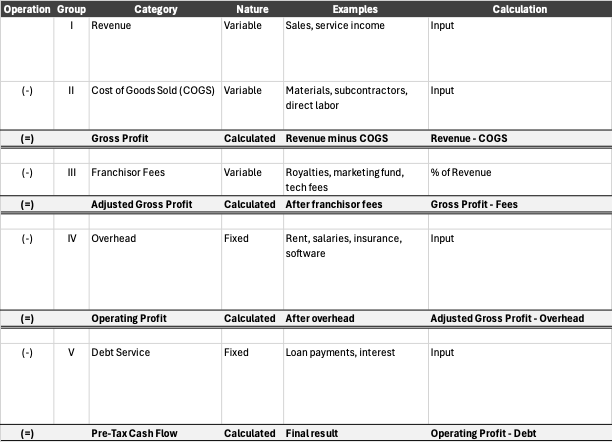
This structure keeps everything organized and easy to follow.
You can clearly see how revenue flows through the business and what is left at the end.
The Most Important Cost Accounts
Usually, the cost accounts that make or break the business are:
Revenue
COGS (Cost of Goods Sold)
Occupancy Costs
Labor
Marketing
Insurance (relevant in certain industries)
Pro Tip: During discovery calls with the franchisor and validation calls with existing franchisees, focus on learning everything you can about these cost accounts.
Breakeven and Revenue Scenarios
Once the structure is in place, you can start testing different revenue levels.
Run a low, mid, and high scenario.
The purpose is to understand where the business breaks even and how profitability expands as revenue increases.
This is where the distinction between fixed and variable costs becomes very practical. Once your fixed costs are covered, additional revenue tends to have a stronger impact on profitability.
Using Validation Calls to Calibrate
At this stage, your model is a draft.
Validation calls help you refine it.
You can ask franchisees if your assumptions are realistic.
Are your cost estimates in line with their experience? Are there expenses you have not considered?
This is where your conversations become much more productive, because you are not asking generic questions. You are testing a model.
Sensitivity Analysis
After calibrating your model, you can test how sensitive the business is to changes.
Adjust one variable at a time.
What happens if revenue is 10 percent higher? What if it is 10 percent lower?
This helps you understand how stable the model is under normal fluctuations.
Stress Test
Finally, combine variables to simulate a more challenging scenario.
For example, revenue is 10 percent lower while fixed expenses are 10 percent higher than expected.
This is not about being pessimistic. It is about understanding the boundaries of the business.
Does profitability decrease but remain manageable, or does the model break down?
In simple terms, you are asking if this is a small hit or a serious issue.
That level of clarity gives you confidence when making a decision.
Final Thoughts
Estimating financial potential is not about complexity. It is about sequence and structure.
It is also not about precision. It is about understanding orders of magnitude and which cost accounts move the needle.
When you start with a focused FDD review and translate it into a simple P&L, you move from uncertainty to clarity very quickly.
You are not relying on opinions or brand perception. You are understanding how the business works and how money flows in and out of it.
And once you have that understanding, evaluating opportunities becomes faster, easier, and far more effective.
__
Curious if Franchising Could Be the Right Fit for You?
If you are exploring business ownership but want structure, clarity, and a professional evaluation process, a Strategy Session is the right first step.
During this conversation, we will:
Clarify your long-term objectives
Discuss budget and investment comfort zone
Evaluate time commitment and involvement level
Identify business models that align with your strengths
Determine whether franchising makes sense for you at all
There is no cost and no obligation. The goal is clarity.
If franchising is a fit, we move forward strategically. If not, you gain clarity before investing time and energy in the wrong direction.
Schedule a complimentary Strategy Session and let’s determine whether franchising is the right path for you.
Our consultation and franchise matchmaking services are complimentary to prospective investors.


