
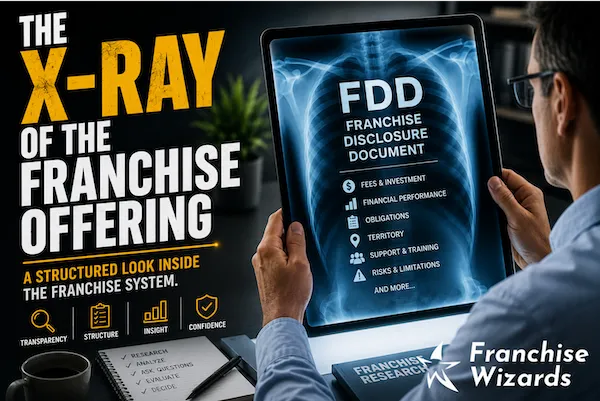
The FDD: The X-Ray of the Franchise Offering
Before You Start Reviewing the FDD
The Franchise Disclosure Document (FDD) is a federally regulated legal document designed to help prospective franchisees receive information in a structured manner and gain a deeper understanding of the franchise offering before entering into a franchise agreement.
In simple terms: the FDD is the X-Ray of the franchise offering.
It gives you visibility into the structure of the business model, the financial framework, the operational expectations, the franchisor-franchisee relationship, the legal framework, and the overall mechanics of the franchise system before you invest.
The FDD follows a standardized structure and includes 23 required sections, commonly referred to as “Items,” which are outlined later in this guide.
Some of these Items focus more on quantitative information, such as startup costs, ongoing fees, financial statements, franchise system growth, and financial performance representations, if provided. Other Items focus more on qualitative information, helping you understand the operational structure of the franchise system, the franchisor-franchisee relationship, territory rights, support systems, and owner obligations.
This guide provides a plain-language overview of the key areas to pay attention to as you review the document.
It is also important to understand that the same franchise brand may include provisions in the FDD that apply only to certain states. These variations are often related to state-level franchise registration requirements and regulations.
An Important Compliance Milestone
The first thing you should do when receiving the FDD is date and sign the receipt page (Item 23) and return it to the franchisor. Signing this page is a compliance milestone, not a commitment to invest. Some franchisors collect an electronic acknowledgment as soon as you open the PDF version of the document.
This step creates a formal timestamp that starts the mandatory 14-day cooling-off period required under franchise regulations. During this period, the franchisor is not allowed to accept signed agreements or investment funds from you.
Why does this waiting period exist?
To deliberately slow the process down and help prospective franchisees avoid making emotional decisions.
Use this time to review the FDD carefully, draft questions that require clarification, conduct validation calls, and schedule follow-up conversations with the franchisor. If you are not comfortable reviewing legal documents, consider engaging the services of a franchise attorney, not simply a general business attorney.
One important mindset shift: many of the provisions outlined in the FDD and Franchise Agreement are designed to protect the franchise system as a whole. The rationale behind many of these legal structures is to ensure that one or two non-compliant or poorly performing franchisees cannot jeopardize the brand, operational standards, or business model for the rest of the network.
How to Use This Document
Although it is important to read this document completely, you may want to review the quantitative items first, which include Items 7, 5, 6, 19, 20, and 21 to get a sense of cost, financial performance, system growth, and franchisor's financial position.
If anything is unclear, ask the franchise development representative for clarification.
Take your time reviewing the FDD. The Franchise Disclosure Document exists to protect prospective franchisees by ensuring they receive key information upfront, while also protecting the franchise system by promoting transparency and legal compliance.
Item 1 – The Franchisor and Any Parents, Predecessors, and Affiliates
Gives background on the company, its ownership structure, and affiliated entities.
Item 2 – Business Experience
Outlines the professional background of the franchisor’s executive team.
Item 3 – Litigation
Discloses any relevant legal actions involving the franchisor or its executives. Most mature systems will have one or more litigation cases. It is important to understand the nature of these cases and whether there is a recurring theme that could be a reason for concern.
Item 4 – Bankruptcy
Covers any bankruptcies filed by the franchisor or its leadership.
Item 5 – Initial Fees
Details the upfront fees required to open the franchise.
Item 6 – Other Fees
Lists ongoing charges such as royalties, marketing contributions, and technology fees, and documents other charges that may be triggered only in special situations. Notice that typically only 4–6 of these fees apply during normal operations. The rest are situational and rarely triggered—but they are disclosed to ensure full transparency.
Item 7 – Estimated Initial Investment
Breaks down the expected costs to launch the business, often shown as a range.
Pro Tip: Never plan your budget based on the minimum side of the investment range. While mathematically accurate, it is unrealistic, as it assumes you will achieve the lowest possible cost for every expense, which rarely happens. Use the cost accounts and values in this table as a starting point, then adapt them to your situation. For example, if you already own a suitable vehicle, you can disregard the leasing cost typically included in the estimate.
Item 8 – Restrictions on Sources of Products and Services
Describes any required suppliers or restrictions on where you can purchase inventory, equipment, or services.
Item 9 – Franchisee’s Obligations
Summarizes the key responsibilities you will take on as a franchisee.
Item 10 – Financing
Outlines any financing options the franchisor may offer.
Item 11 – Franchisor’s Assistance, Advertising, Computer Systems, and Training
Explains what support and training will be provided before and after launch.
Item 12 – Territory
Defines the scope of your protected territory, if applicable.
Item 13 – Trademarks
Lists the registered trademarks, brand names, and logos you’ll have the right to use.
Item 14 – Patents, Copyrights, and Proprietary Information
Covers other forms of intellectual property used in the business.
Item 15 – Obligation to Participate in the Actual Operation of the Franchise Business
Explains whether the franchisee must be involved in daily operations or can be semi-absentee.
Item 16 – Restrictions on What the Franchisee May Sell
Outlines limitations on products or services you’re allowed to offer.
Item 17 – Renewal, Termination, Transfer, and Dispute Resolution
Explains the length of the agreement and your rights when it ends or if you wish to exit.
Item 18 – Public Figures
Discloses whether any celebrities or well-known personalities are associated with the brand.
Item 19 – Financial Performance Representations (FPRs)
Shows financial results of existing franchise units, if the franchisor chooses to disclose them. Even if financial performance data is provided, it should never replace your own due diligence. Validation calls with existing franchisees remain essential for understanding the real-world application of the business model and financial expectations.
Item 20 – Outlets and Franchisee Information
Provides data on the number of franchised and company-owned units, including openings, closures, transfers, and terminations over the past three years.
Most mature franchise systems will show some terminations, which is normal. It’s important to understand that a franchise agreement may end for reasons unrelated to the quality of the business model such as divorce, illness, relocation, retirement, or even the death of the franchisee. As a prospective franchisee, you have the right to know and ask about these events during validation calls and understand the context behind them.
Item 21 – Financial Statements
Provides audited financial statements for the franchisor.
Item 22 – Contracts
Lists and includes all agreements you’ll be asked to sign.
Item 23 – Receipts
Acknowledges that you’ve received the FDD. Signing this page does not commit you to anything, it only timestamps when you received the document.Best Practices When
Reviewing the FDD
If you have difficulty reading or understanding the Franchise Disclosure Document, consider contracting the services of a franchise attorney to help you review the document and identify anything that may require clarification. Google "Flat fee FDD review".
Notice the wording here: franchise attorney, not simply business attorney.
Franchise agreements are highly specialized legal documents, and franchise law has its own regulatory framework and industry practices.
That said, it is important to maintain realistic expectations regarding what franchise attorneys typically negotiate.
Pro Tip: Do not expect franchise attorneys to negotiate reductions in franchise fees, royalties, or other core economic terms of the franchise model.
Franchising is built around uniformity of the franchise offering. The franchisor must maintain consistency across the system, not only operationally, but also economically.
Think about it from the perspective of the franchise network itself. How would you feel if you later discovered that another franchisee operating under the same brand had negotiated a lower royalty structure than yours?
The purpose of a franchise attorney is generally not to “beat up” the franchisor or renegotiate the business model. Their role is to help you understand the legal relationship, identify unusual provisions, explain your obligations, and make sure you clearly understand what you are signing.
Guidance Every Step of the Way
If you are considering exploring franchise opportunities and want guidance, structure, and support throughout the process, that is exactly what we do at Franchise Wizards.
We help prospective franchisees identify franchise business models that align with their goals, budget, lifestyle, and desired level of involvement. We also guide them through the discovery process step-by-step and provide best practices for franchise evaluation.
A complimentary Strategy Session is usually the best place to start.
During this conversation, we will:
Discuss your long-term goals
Review budget and investment comfort zone
Evaluate desired time commitment and ownership style
Discuss different franchise business models and operational structures
Identify opportunities that may align with your strengths and preferences
Outline best practices for franchise evaluation and validation
Determine whether franchising makes sense for you at all
There is no cost and no obligation.
The goal is to help you approach the process with more clarity, structure, and confidence while avoiding common mistakes first-time franchise candidates often make during discovery.
If franchising is a fit, we support you throughout the process. If not, you walk away with a better understanding of your options and decision-making criteria.
Schedule a complimentary Strategy Session and let’s determine whether franchising is the right path for you.
Our consultation and franchise matchmaking services are complimentary to prospective investors.


